




Various systems and technologies are available at Hightex for the series production of near-net-shape 3D preforms.
In order to be able to produce exact preform geometries, the precise cutting of individual layers for a fibre composite component is of crucial importance. Depending on the preform requirements, we are able to select the optimum cutting technology. Whether you need single layers with high precision or several identical layers, we have the right cutting technology for all applications.
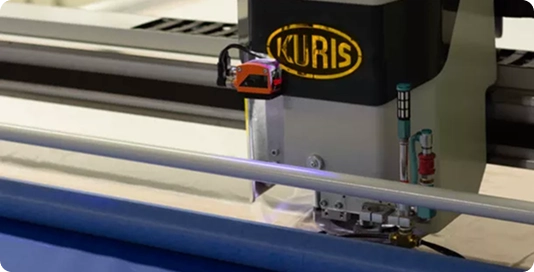
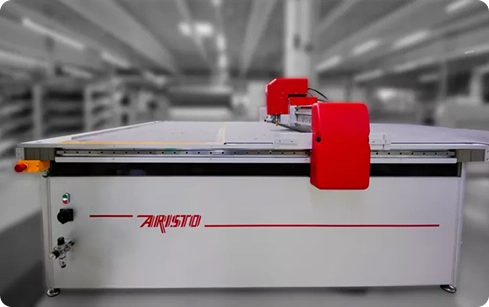
Several single and multi-layer cutters are used for cutting high-precision single layers, as are primarily used in aerospace series production. These can be used to quickly and easily cut a wide variety of individual layers with a high degree of accuracy, as every single gram is often too much to avoid.
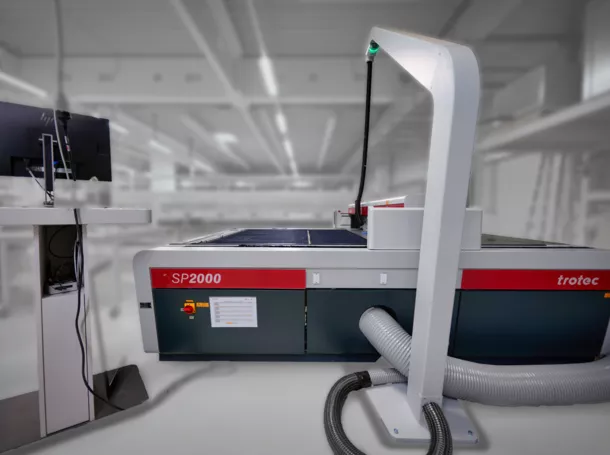
Our cutting technologies are complemented by two laser systems, which enable the cutting of glass layers in particular without fraying the cutting edge. The laser has also been used for years as part of A-350 window frame series production to remove the GF embroidery base from the TFP subpreforms in a semi-automated process before window frame assembly, thus contributing to efficient and reproducible CWF series production.
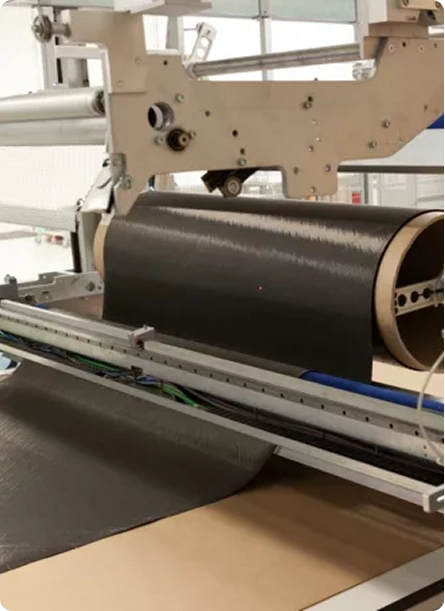
Our cutting machine park is complemented by a roller punching machine, which enables fast and uncomplicated cutting of 2-dimensional single and multi-layer preforms with high precision. Furthermore, a wide variety of cutting technology is used, particularly in our special and research projects, such as electric rotary knives or shears for creating free-form contours on final components and preforms.
On our multi-layer cutter in combination with a fully automatic laying device, large quantities of stacks with individual layer structures can be realised within a very short time, which can be cut to the required final contour after depositing. This allows a wide variety of 2-dimensional textile semi-finished products to be laid down automatically in any order. In the past, preforms for floor panels for aviation applications have been produced in series using this system. A special feature here was the use of so-called spunfab as a connecting layer between the individual CF layers. The result is a handling-stable, near-net-shape panel, even with foam or CF inserts depending on the variant.
We are constantly endeavouring to expand our expertise in the field of making up and cutting all types of semi-finished textile products and preforms.
