Components that can withstand the extreme demands of space travel - whether temperature, vibration or force.
With Tailored fibre placement (TFP), Dry-filament winding, Binding, Precise cutting and automatic preforming we deliver Preforms suitable for space travel - reproducible, near-net-shape and process-reliable for RTM/infusion or thermoplastic consolidation.
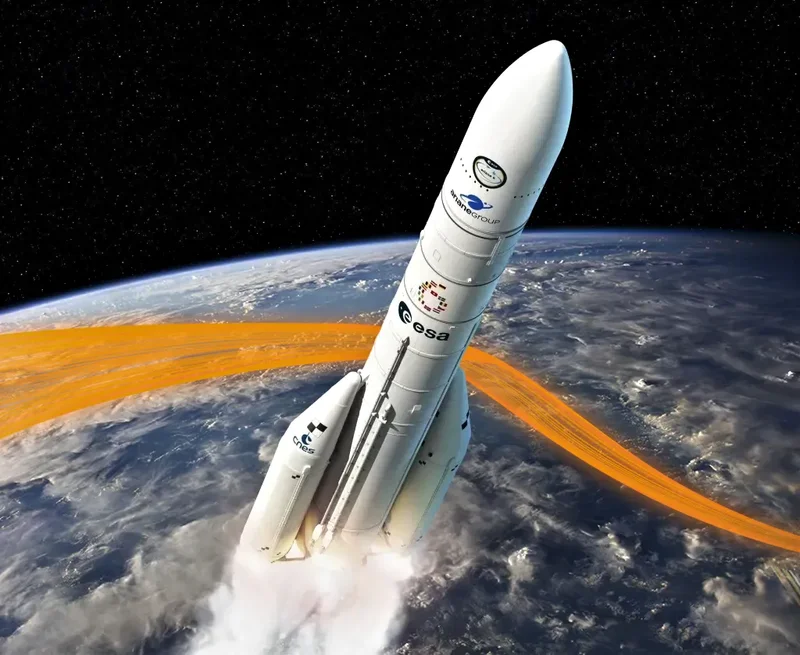
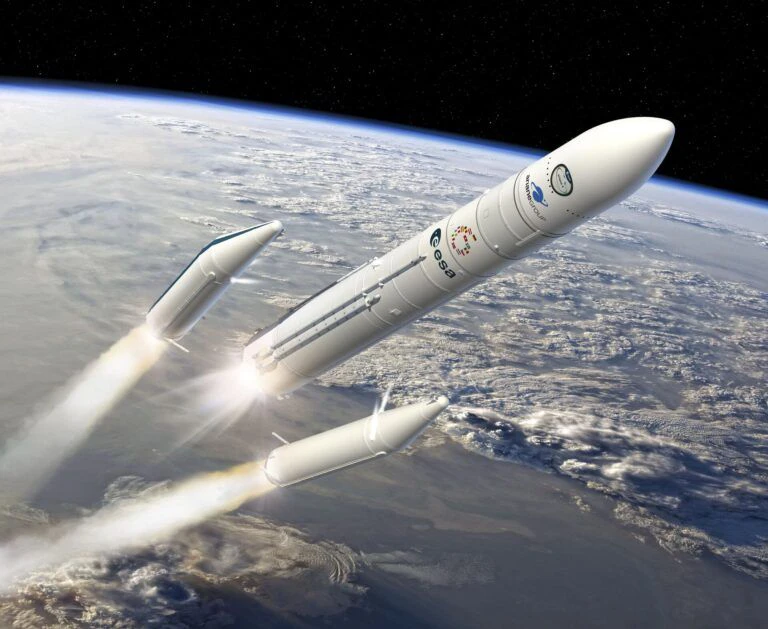
Hightex points the way for Ariane 6
Hightex is supplying key components of the propulsion system for the European Space Agency's Ariane 6 launch vehicle, which has been in operation since 2024. The hemispherical preforms form part of the solid-state joint, which is used to swivel the engines of the boosters and main stages and thus control the trajectory of the rocket.
The particular challenge with these shell preforms is to ensure precise and reproducible fibre orientation in the spherical coordinate system over the entire spherical geometry.
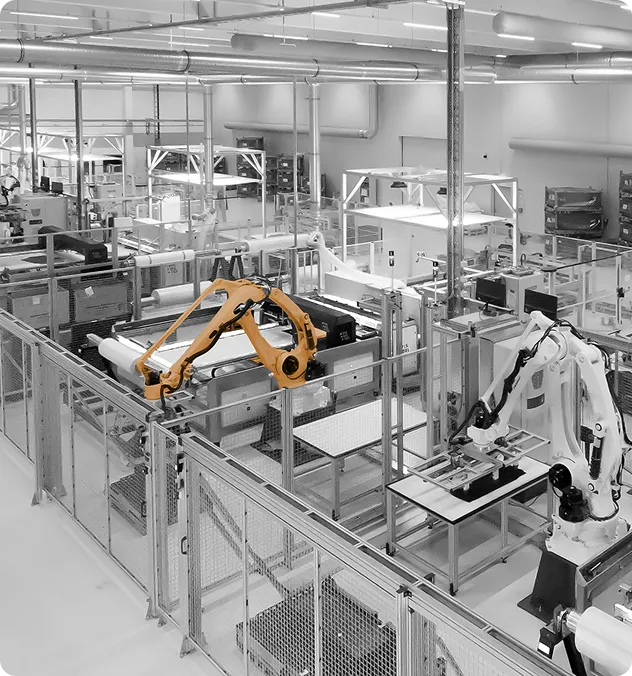
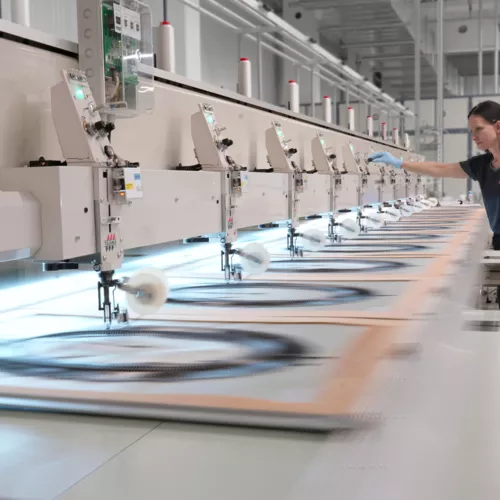
For the realisation of the preform and the required fibre orientations, the established TFP technology was further developed into a series process using dry filament winding technology. This process is supported by a large number of heatable preform tools, which are used to consolidate the individual sub-preforms. They are then assembled into the overall component. Not only are the individual steps of the production process largely automated, but end-to-end digitalisation and recording of the critical process parameters also ensure efficient and reproducible series production of these preform components. The technology is easily scalable in terms of both dimensions and quantities.
Load-path-compatible preforms with variable fibre trajectory; can be combined with binders for 3D dimensional stability.
defined winding angles and layer structures on complex, even spherical contours.
Activatable binder for mountable textiles and moulded preforms; Temperature/pressure profiles for reproducible draping.
Single-layer & multi-layer cutter, Laser (clean GF edges), Roll punching machine for high quantities.
Robot handling, buffer, transfer to RTM/infusion or thermoplastic consolidation.
Geometry and web position control, area weights, parameter logging, series documentation.
In space travel, TFP is indispensable for coping with extreme launch loads while minimising payload mass, for example through targeted reinforcements on highly stressed tank structures or satellite mounts. As every gram of weight incurs enormous costs, the precise, load-path-optimised fibre guidance enables radical material savings while maintaining maximum structural integrity. The process is also perfect for the loss-free processing of expensive high-performance fibres that have to withstand extreme temperature changes in space.
Shell/dome preforms, rings, brackets, secondary structural components, local reinforcing elements
Lightweight beams, panels, holders/brackets, frame and stringer preforms
contour-true preforms with tight tolerances and clean edges for precise assembly chains
Fibre angle and mass tolerances, geometry, surface quality Validated for specific components.
CF/GF types, binders, embroidery base, resin/matrix systems on Thermal, vacuum and outgassing requirements coordinated.

Batches, process parameters, test plans; on request ECSS/customer reporting.
EN 9100:2018, ISO 9001:2015 (certificates available).
(We define specific targets together for each component).
Over 20 years of experience in fibre composites & lightweight construction. Focus: load-path-compatible preforms (TFP), precise cutting/stacking, binder-based 3D preforms and automatic preforming for RTM/infusion - from prototype to series production.
Co-engineering, sampling, series production transfer - we plan and realise your space-qualified preform.