binders, the basis of stable 3D preforms
Bonded fibres and semi-finished products can be reliably shaped on preform tools - close to the final contour, reproducible and ready for RTM, infusion or thermoplastic processes. Hightex develops and manufactures binderised rovings and textile semi-finished products in series quality.





At the Binding a thermoplastic Powder connector applied to fibres or textile semi-finished products. When processing the semi-finished products, the binder can be mixed with Pressure and temperature and thus permanently fix the textile geometrically. The fixed textiles can be on preforming moulds into any three-dimensional contour and thus save time and costs during further processing.
For the Standard binding of rovings Hightex has a industrial binding process developed, which Continuous and reproducible application of the powder. The amount of binder in the final component can be controlled precisely and in very small quantities (0...5%) in order to minimise the impact on the resin system. Due to the thermoplastic properties of the binder, the binderised rovings can be TFP in connection with forming processes near-net-shape preforms process. The stable preform can then be moulded, e.g. via RTM be infiltrated into the component.
Derivation of the desired fibre courses from simulation and design data.
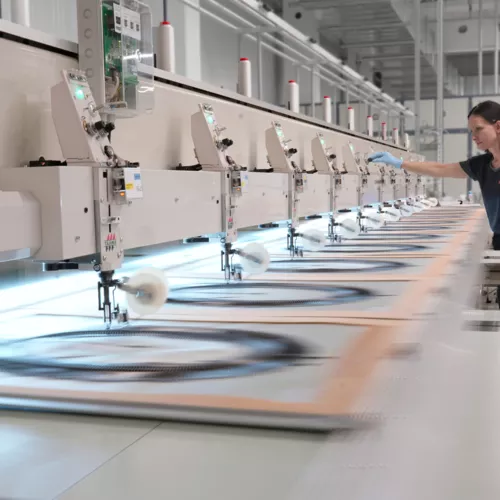
Transfer of the fibre course into CNC embroidery paths with defined stitch width and sewing parameters.
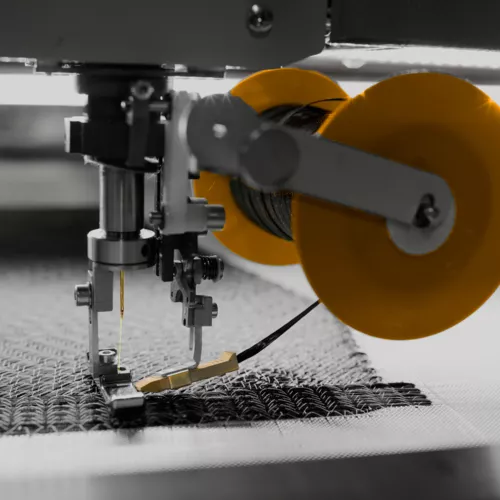
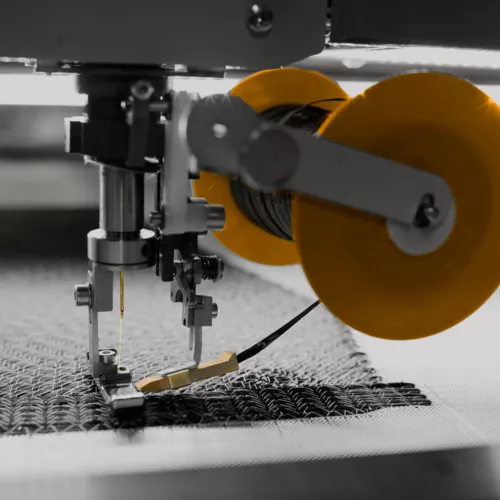
Curved, stress-appropriate placement of the rovings on the embroidery base, including defined spreading of the rovings.
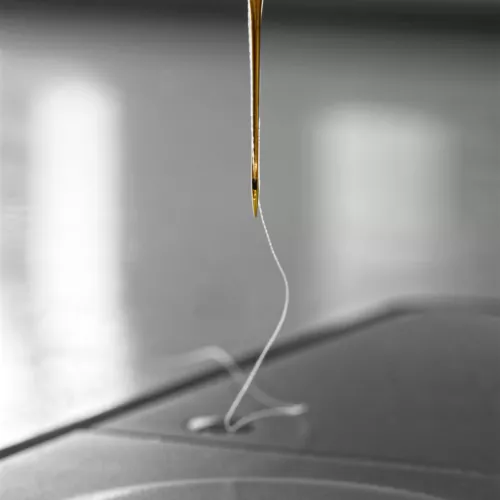
Sewing on the rovings (upper/bottom thread) - compatible with later resin/matrix system.
Formation of sub-preforms; if necessary, joining of several substructures, draping for double-curved geometries.

Binder behaviour (tack, reactivation), temperature window, pressure/pressure, cycle time, binder content, cleanliness of the line - everything is taken into account at Hightex Optimised for the application and the ideal parameters selected.

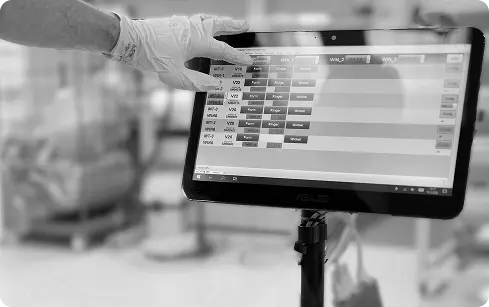
Constant binder application: Inline monitoring and recording of all relevant process variables.
Reactivability & Tack: designed for component geometry and process (TFP, draping).
Cleanliness & surface quality: Powder/fibre contact, low particle migration, defined edges.
Examinations (exemplary): Peel-off/peel impression, binder mass percentage, visual inspection, handling stability, documented parameter windows.
Documentation: Seamless and complete documentation for traceability.
Aviation window frame preform (CF/RTM)
Initial situation: complex, circumferential window frame with varying wall thickness, several openings and tight radii; previously high reject rate and creasing during manual lamination.
Solution: CF rovings trimmed, TFP sub-preforms manufactured for the critical zones (corners, radii, load paths) and joined on a heated preform mould. Result: dimensionally stable 3D preform over the entire window frame, significantly reduced reworking, process-reliable RTM with reproducible quality and noticeably less waste.
To ensure that fibres/semi-finished products are not damaged during draping or on the preform tool Dimensionally stable remain and as clean 3D preform into the component process - without slipping or fibre faults. So that the fibre is where it belongs.
Not quite. Our continuous binding process is specially designed for carbon and glass rovings. We can bind fabrics and scrims by hand if required, e.g. in critical areas - but not in the same continuous process as rovings.
Yes, we ensure this on a project-by-project basis. Binder, yarn and matrix compatibility are part of our engineering.
Yes, the binder provides the necessary Tack stability for TFP trays and downstream 3D moulding.
Through More stable preforms reduce rework and rejects; near-net-shape Storage reduces waste. All in all, the process more economical - especially in the Series.
We place these Application-specific (binder chemistry, roving, tool, process). Goal: Secure activation with robust handling.
We develop binder setups, semi-finished products and process windows to suit your application - from the Sampling up to the Series.